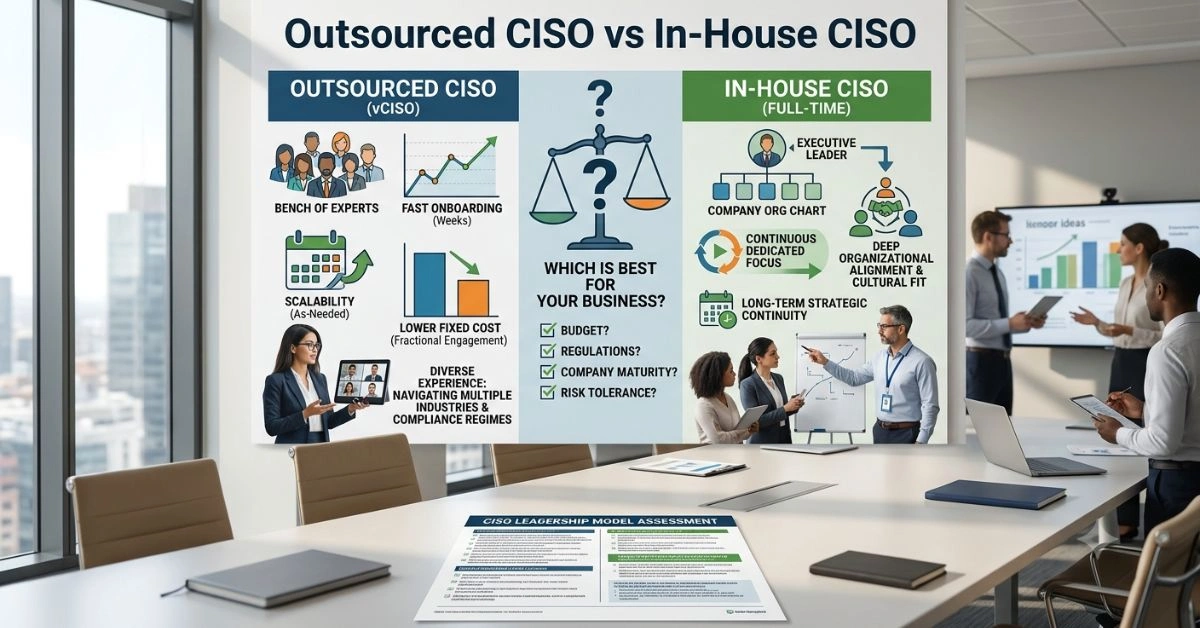
In today’s threat landscape, where breaches make headlines weekly and regulators tighten scrutiny, many organizations face a high-stakes choice: embed a full-time Chief Information Security Officer (CISO) within their leadership ranks or engage an outsourced/virtual CISO (vCISO) for strategic oversight. This isn’t merely a staffing decision—it’s a fundamental bet on how security leadership integrates with business velocity, risk tolerance, and long-term resilience.
SMBs and mid-market enterprises, in particular, grapple with this amid talent shortages, escalating cyber risks, and pressure to demonstrate mature programs to customers, insurers, and boards. Neither model is universally superior. The optimal path hinges on your organization’s maturity, scale, regulatory exposure, and appetite for internal ownership versus external agility.
Cost-Efficiency and Talent Access: The Outsourced Advantage
Outsourced or fractional CISOs deliver senior expertise at a fraction of the fully-loaded cost of an in-house hire. Total compensation for a seasoned in-house CISO often exceeds $300,000–$500,000 annually (including benefits, equity, and overhead), with large enterprises pushing well beyond $1 million in some cases. Hiring cycles stretch 6–12 months, followed by ramp-up time. In contrast, vCISO engagements typically range from $3,500–$15,000 per month, offering 60–80% savings while providing immediate deployment—often within days or weeks.
This model shines in rapid access to diverse, battle-tested talent. A good vCISO provider draws from a bench of specialists who’ve navigated multiple industries, threat environments, and compliance regimes. They bring fresh perspectives, proven playbooks for incident response, vendor risk management, and zero-trust transformations—assets hard to replicate with a single internal hire who may have narrower prior exposure. Scalability is another strength: ramp services up during mergers, audits, or crises, then dial back without severance or cultural disruption.
For growing companies or those in transitional phases (e.g., post-funding, pre-IPO, or navigating new market entry), this flexibility accelerates security maturity without anchoring fixed overhead.
Depth, Alignment, and Dedicated Focus: The In-House Edge
An in-house CISO becomes woven into the organizational fabric. They develop intimate knowledge of proprietary systems, business processes, culture, and unspoken risks that external eyes might miss. This translates to nuanced risk decisions, seamless cross-functional influence (e.g., with engineering, legal, and sales), and long-term strategic continuity that compounds over years.
Dedicated focus means undivided attention during board meetings, incident escalations, or culture-building initiatives like security awareness programs. Cultural alignment often feels more authentic; the CISO isn’t juggling multiple clients but lives the company’s mission daily. For highly regulated or complex environments—think distributed global operations, sensitive IP, or industries with unique threat models—this embedded perspective can reduce blind spots and foster proactive, context-aware defenses.
However, this comes with trade-offs: higher costs, retention risks (average CISO tenure hovers around 2–3 years due to burnout and pressure), and potential skill gaps if the hire’s experience doesn’t perfectly match evolving needs.
Real-World Challenges: No Model Is Bulletproof
Outsourced providers can suffer from divided attention. Serving multiple clients means your urgent issue might compete for bandwidth, especially during widespread threat events. Organizational knowledge builds slower, and integration requires deliberate effort—regular cadences, knowledge-sharing protocols, and clear SLAs—to avoid a “consultant vs. owner” dynamic. Over-reliance on external perspectives risks generic recommendations that overlook internal nuances.
In-house leaders face their own pressures: isolation in under-resourced teams, difficulty staying current across the full spectrum of threats and technologies without broad peer networks, and the risk of becoming a single point of failure. High salaries don’t guarantee retention in a competitive market, and a poor cultural fit can stall progress for years.
Hybrid approaches—such as a fractional vCISO paired with strong internal deputies or transitioning from outsourced to in-house as the program matures—often mitigate these weaknesses.
A Practical Decision Framework
Choosing requires honest assessment across several dimensions:
Budget and Financial Maturity: If your security budget is under ~$200K–$300K annually or you need to preserve capital for growth, start with outsourced. The ROI is faster for companies prioritizing immediate risk reduction and compliance posture over long-term institutionalization. Larger enterprises with stable revenue and board-mandated executive accountability often justify the in-house investment.
Regulatory and Compliance Demands (GDPR, HIPAA, etc.): Heavily regulated sectors (healthcare, finance, critical infrastructure) benefit from in-house depth for ongoing accountability, audit defense, and demonstrable executive ownership. However, vCISOs with specialized compliance track records can efficiently prepare for certifications, gap analyses, and initial program builds—especially valuable for SMBs facing customer-driven requirements or impending audits. Neither absolves ultimate liability; strong contracts, BAAs, and governance are essential in outsourced scenarios.
Growth Stage and Security Maturity: Early-stage or rapidly scaling companies with nascent programs gain the most from vCISOs—gaining executive-grade strategy without the hiring lag. Mature organizations with complex, bespoke environments (legacy systems, heavy customization, or high-stakes IP) typically need an in-house leader for sustained ownership. If you’re in transition (e.g., building a SOC, responding to a breach, or preparing for acquisition), outsourced provides surge capacity.
Other Factors: Evaluate internal bandwidth (can existing IT/leadership absorb partial CISO duties?), risk appetite (need for 24/7 strategic availability?), and willingness to invest in relationship management for outsourced models. Pilot engagements with vCISOs can de-risk the decision before committing to a full-time hire.
Moving Forward Strategically
The “right” choice evolves. Many successful organizations begin with outsourced leadership to establish foundations, then transition to in-house as scale and complexity demand it. What matters most is treating security leadership as a capability, not just a title—ensuring accountability, measurable outcomes, and alignment with business objectives regardless of the delivery model.
As a cybersecurity strategist, my advice is pragmatic: Assess ruthlessly against your current realities, not aspirational ideals. Engage providers or recruiters transparently, define success metrics upfront (e.g., reduced risk exposure, audit readiness timelines, incident response improvements), and build mechanisms for knowledge transfer. In an era of relentless threats and talent scarcity, the winners won’t be those who pick the “best” model in theory—but those who implement the one that best fits their context today while positioning them to adapt tomorrow.
FAQS
1. What is the difference between an outsourced CISO and an in-house CISO?
An outsourced CISO (vCISO) provides cybersecurity leadership on a contract or part-time basis, while an in-house CISO is a full-time executive dedicated to your organization’s security strategy and operations.
2. Is hiring an outsourced CISO more cost-effective?
Yes. For many small and mid-sized businesses, an outsourced CISO delivers experienced security leadership at a significantly lower cost than hiring a full-time executive.
3. Which businesses benefit most from an in-house CISO?
Large enterprises, highly regulated organizations, and companies with complex IT environments often benefit from an in-house CISO because they require continuous oversight and deep organizational knowledge.
4. Can a company switch from an outsourced CISO to an in-house CISO later?
Absolutely. Many businesses start with a vCISO to build their cybersecurity program and later hire a full-time CISO as the company grows and security needs become more complex.
5. What factors should I consider before choosing a CISO model?
Consider your budget, company size, regulatory requirements, cybersecurity maturity, growth plans, and the level of ongoing security leadership your organization requires.
For More Information Visit AmgNews.