

In switchgear production, the core engineering challenge has always been transforming raw copper or aluminum bars into precise, reliable conductors that can handle high currents without failure, while meeting tight tolerances in crowded enclosures. Delays in busbar fabrication ripple through assembly lines, inflate costs, and compromise safety in power distribution systems. Traditional manual methods struggle here, but CNC busbar machines are changing the equation.
The Limitations of Traditional Busbar Processing
For decades, electrical panel builders relied on manual or semi-automatic tools. Operators would measure, mark, cut with band saws or guillotines, punch holes using turret punches or drill presses, and bend bars over manual benders or with hydraulic presses guided by templates.
This approach demanded skilled labor for every step. A single mistake in measurement could scrap an expensive bar. Bending copper or aluminum introduced springback—the tendency of the metal to partially return to its original shape after forming—requiring repeated adjustments and test bends. Accuracy often hovered around 1 to 2 mm or several degrees, leading to fitment issues in switchgear assemblies. Material waste ran high from trial-and-error cuts and off-spec bends. Safety risks were significant: heavy bars, sharp edges, repetitive strain, and the potential for hydraulic failures or flying metal fragments.
Production rates stayed low. A team might process a handful of complex busbars per shift, with quality varying between operators. In an era of rising demand for customized low- and medium-voltage switchgear—driven by renewable integration, data centers, and industrial automation—this bottleneck became unsustainable.
What CNC Busbar Machines Actually Do
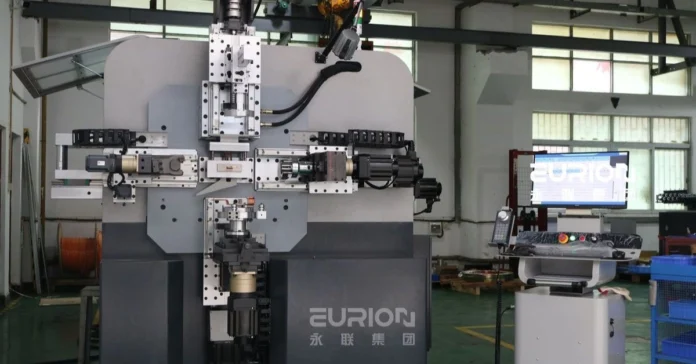
CNC busbar machines integrate punching, cutting, and bending into automated, programmable systems that handle copper and aluminum bars up to 200mm wide and 12-20mm thick, depending on the model. A typical 3-in-1 or multi-station unit uses servo-driven positioning, hydraulic or electric actuators, and CNC controllers with touchscreens or offline programming software.
- Cutting: High-precision shearing or sawing stations deliver clean, burr-free ends with repeatability within fractions of a millimeter. No more manual measuring and deburring.
- Punching: Multi-station tooling or automatic tool changers create round, oblong, or custom holes for connections. Patterns can be programmed for entire sequences.
- Bending: The heart of the machine. Powered by hydraulic rams or servo motors, these stations form precise angles—flatwise, edgewise, or combinations—using V-dies, rotary benders, or specialized tooling.
What sets CNC apart is the control layer. Operators input dimensions, angles, and sequences via software. The machine’s servo stoppers automatically position the bar for each operation, often with one-time clamping for multiple processes. Advanced models feature multi-station tooling, allowing parallel or sequential operations without repositioning, and springback compensation systems.
Springback compensation works through real-time sensors or pre-programmed algorithms that measure bend angle during or after the stroke and automatically overbend by the calculated amount (typically 1-5 degrees depending on material thickness, alloy, and temper). This delivers consistent results across batches, even with varying material properties.
Precision, Waste Reduction, and Safety Gains
Field data shows clear advantages. CNC systems routinely achieve angle accuracy of plus-minus 0.5 degrees or better and linear tolerances of ±0.1-0.2 mm. This precision ensures busbars fit perfectly into switchgear enclosures the first time, reducing rework and improving electrical contact surfaces that minimize resistance and heat buildup.
Material waste drops dramatically—often by 20-25%—because optimized nesting software calculates exact cut lengths and bend allowances upfront. Scrap from misbends or oversize allowances nearly disappears. One manufacturer reported cutting waste by nearly a quarter after switching to precision CNC processing for aluminum busbars.
Safety improves on multiple fronts. Automation removes operators from direct contact with heavy, sharp-edged bars during high-force operations. Enclosed stations, light curtains, and two-hand controls reduce pinch points and flying debris risks. Reduced physical strain lowers long-term injury rates in panel shops, where repetitive bending and lifting once dominated.
Throughput multiplies. Servo positioning and automated cycles can boost productivity 3-5 times over manual methods. Setup times for new designs plummet from 30-45 minutes to under 10, enabling economical small-batch or highly customized production.
Real Impact on Switchgear and Power Distribution
In switchgear production, these machines enable tighter packing of components, supporting higher power densities demanded by modern grids. Complex busbar geometries—offsets, twists, multiple bends in short spans—become routine rather than engineering headaches. This flexibility matters for applications like UPS systems, PDU racks, energy storage, and renewable interconnections.
Companies like Schneider Electric and others have adopted CNC busbar lines, reporting fewer defects (one case dropped bending-related issues from 12% to under 2%) and faster time-to-market for custom panels. Larger players in India and elsewhere integrate them for high- and low-voltage equipment, where busbar quality directly affects system reliability.
Looking ahead, integration with CAD/CAM ecosystems, robotic loading/unloading, and even AI-driven predictive maintenance will further streamline lines. As power distribution shifts toward smarter, more resilient networks, the ability to rapidly produce reliable, low-loss busbars becomes a competitive edge.
Practical Considerations for Implementation
Not every shop needs the largest fully automatic line. Smaller fabricators might start with a compact 3-in-1 CNC unit, while high-volume producers invest in automated cells with material handling. Key selection factors include maximum bar dimensions, required throughput, software ease (offline programming compatibility), and service support. Training is straightforward—experienced operators adapt quickly to the CNC interface.
Initial investment pays back through labor savings, reduced scrap, and higher-quality output that commands better margins or wins more contracts. Maintenance focuses on hydraulic systems, tooling wear, and software updates, all manageable with standard industrial practices.
The transition isn’t without challenges—programming learning curves for complex parts or material variability require initial attention—but the engineering payoff is substantial.
CNC busbar machines represent a quiet but profound shift in how we build the backbone of electrical infrastructure. They move switchgear production from craft-based variability toward engineered precision and scalability. For industrial engineers and panel builders focused on reliability, efficiency, and future-proofing operations, this technology isn’t optional—it’s becoming fundamental to staying competitive in the evolving power distribution landscape.
FAQs
1. What is a CNC busbar machine?
A CNC busbar machine is an automated system that cuts, punches, and bends copper or aluminum busbars with high precision.
2. Why are CNC busbar machines better than manual methods?
They improve accuracy, reduce material waste, increase production speed, and enhance workplace safety.
3. Which industries use CNC busbar machines?
They are widely used in switchgear manufacturing, electrical panel production, power distribution, and industrial automation.
4. Can CNC busbar machines handle complex busbar designs?
Yes. They can produce precise bends, hole patterns, and custom shapes for modern electrical systems.
5. Are CNC busbar machines worth the investment?
Yes. They reduce labor costs, improve product quality, and deliver long-term savings through higher efficiency.
For More Information Visit AmgNews.