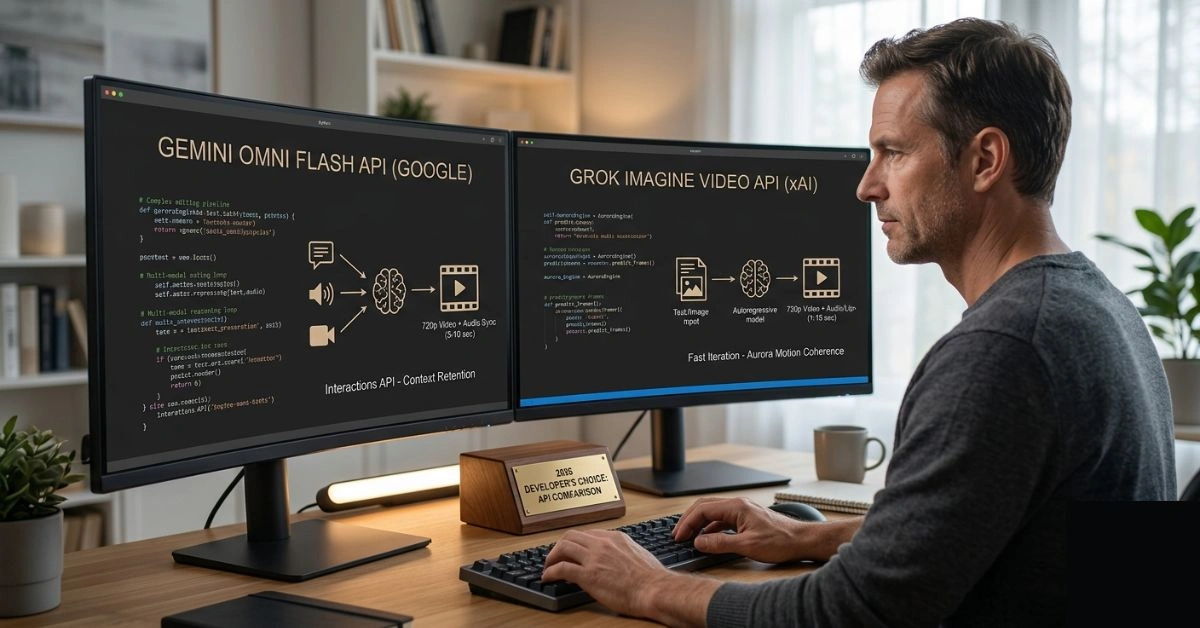
In 2026, video generation APIs have matured beyond basic text-to-video prompts. Latency, motion coherence, native audio synchronization, and iterative editing define production viability for developers building short-form content tools, ad generators, prototyping pipelines, or agentic video workflows. Both Google’s Gemini Omni Flash (often referenced via Fast/Interactions paths) and xAI’s Grok Imagine Video API target similar 720p use cases but approach the problem with distinct architectures and trade-offs.
Under the Hood: Gemini Omni Fast/Flash API Architecture
Gemini Omni Flash operates as a unified multimodal model leveraging Gemini’s core reasoning backbone integrated with video generation capabilities. It processes text, images, audio, and video inputs simultaneously in a single forward pass where feasible, with strong emphasis on conversational refinement.
Key architectural elements include:
- Multi-turn conversational editing via the Interactions API: Maintains session context across turns. Developers upload a base video or generate one, then issue natural language instructions like “replace the background with a stormy Tokyo street, adjust lighting to be warmer, and slow the camera pan.” The model preserves character consistency, physics, and unmentioned elements without full re-generation from scratch. This reduces token waste and iteration time compared to prompt-only regeneration.
- Reference image handling: Supports up to 5–7 reference images for subject/style consistency. Inputs are tokenized efficiently (e.g., ~2040 tokens per image).
- Output constraints: Native 720p (1280×720) at 16:9 or 9:16. Typical clip lengths are 3–10 seconds. Longer outputs require stitching. It generates synchronized audio in the same pass but prioritizes visual coherence and world-model reasoning (physics, anatomy, lighting) over raw motion fluidity in some edge cases.
- Practical pipeline notes: In Google Cloud/Gemini API consoles, you work with the Interactions API for stateful sessions. Pricing is ~$1.50 per 1M input tokens + ~$0.10 per second of 720p video output (billed via ~5,792 output tokens per second). This makes iterative editing cost-effective once the base clip exists, but initial generations add up quickly for high-volume testing.
From building pipelines, the strength is in agentic or iterative developer workflows—e.g., prototyping marketing variants or refining VFX elements conversationally—where context retention shines. Limitations include the 10-second practical cap per generation and heavier reliance on Google’s ecosystem for optimal performance.
The Challenger: Grok Imagine Video API
Grok Imagine leverages xAI’s Aurora engine, an autoregressive mixture-of-experts architecture optimized for sequential frame prediction and native multimodal (video + audio) synthesis. It emphasizes single-pass generation with strong motion coherence.
Standout technical features:
- Aurora-engine motion coherence: Autoregressive design predicts frames sequentially, maintaining subject position, lighting continuity, and camera trajectories better across the full clip. This reduces common artifacts like flickering or drift seen in some diffusion-heavy approaches.
- Unique single-pass synchronized native audio/lip-sync: Generates video, dialogue, SFX, ambient sound, and lip movements in one inference pass. No separate post-processing or audio models needed for basic synced output. Excellent for character-driven shorts.
- Python SDK ecosystem: Straightforward official and community SDKs (e.g., via fal.ai, direct xAI endpoints). Parameters are explicit: duration (1–15 seconds integer), resolution (“720p” or “480p”), aspect_ratio, reference images. Fast iteration for scripting batch jobs or integration into tools like Replicate.
- Performance profile: Up to 15-second clips at 24 FPS, 720p primary output. Reported latencies around 20–45 seconds for a 5–8 second 720p clip with audio. Pricing is competitive (often cited lower per second than equivalents, with audio included). Strong instruction following for editing (restyle, add/remove objects, motion control).
In practice, Grok Imagine excels in rapid prototyping of complete, audio-native clips. The Python-first experience and longer max duration reduce stitching overhead. Trade-offs include potentially less sophisticated multi-turn conversational depth compared to Gemini’s Interactions API, favoring single-shot or scripted refinements.
Technical Specification Comparison (2026)
| Feature / Model | Gemini 3.5 Flash API | Grok Imagine Video API |
| Primary Output Pricing | $1.50 per 1M input / $9.00 per 1M output tokens | $0.05 per second (480p) / $0.07 per second (720p) |
| Media Modality | Multi-modal (Text, Audio, Video Output natively) | Dedicated Video Generation (Text/Image to Video) |
| Context / Limits | 128K context window with prompt caching | 70 requests per minute ceiling |
| Best Used For | High-speed agentic loops and multi-modal apps | Fast, high-fidelity creative video asset generation |
\n> Developer Compliance Note: While Gemini 3.5 Flash provides unmatched speed for multi-modal text and structure routing, xAI’s grok-imagine-video endpoint charges strictly on a per-second execution layer. For production pipelines, implementing client-side debouncing and strict output duration limits is mandatory to prevent unexpected multi-dollar api bills during automated loops..
Which API Should You Choose?
- Choose Gemini Omni Flash for complex editing pipelines or agentic applications. Example: A content automation tool where a base ad clip is generated, then iteratively refined across 3–5 turns (“change product color, add voiceover instruction, adjust pacing”) while preserving brand assets. Its Interactions API and Gemini reasoning backbone handle long-context multi-modal state exceptionally well. Ideal when building on Google Cloud or needing deep world/physics understanding.
- Choose Grok Imagine Video API for instant, self-contained 10–15 second clips with production-ready audio sync. Example: Social media short generators, quick storyboarding, or character animation prototypes where you want a complete clip (video + sound) in one call with minimal post-production. The Aurora motion quality and Python SDK make it a strong fit for indie devs or high-throughput batch jobs.
Hybrid approaches are viable: Use Grok for initial high-motion audio clips, then import into Gemini for fine conversational polishing if your pipeline spans providers.
Conclusion: The Current State of Developer-Accessible AI Video Generation
As of mid-2026, neither API dominates universally—Gemini Omni Flash leads in iterative, conversational control and multimodal reasoning depth, while Grok Imagine Video delivers faster single-pass audio-native output with solid motion coherence and longer clips. Both operate comfortably at 720p with practical developer pricing under $0.10–0.15 per second in typical usage, making high-quality video generation accessible beyond big studios.
The battleground has shifted to integration ergonomics, latency in real pipelines, and how well the model fits your specific editing vs. generation ratio. Test both via their consoles and SDKs with your representative workloads—benchmarks on paper rarely match production friction around reference handling, cost accumulation, and output consistency. The winner for your project will come down to whether your workflow values conversational refinement or coherent, ready-to-ship single shots.
For More Information Visit AmgNews.