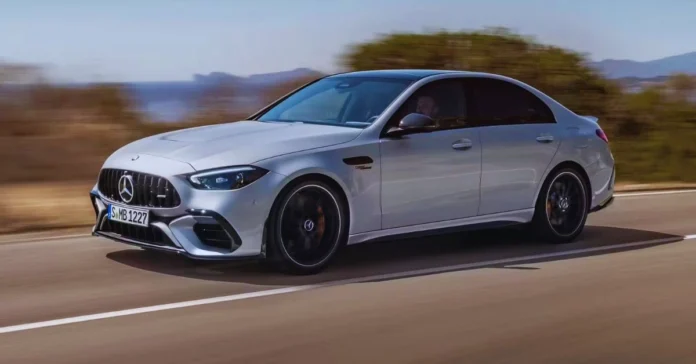


The Mercedes-AMG C63 has always been the poster child for accessible super-sedan performance. For years, it delivered its thrills through big-displacement V8s that howled and shoved with raw mechanical character. Now, the latest C63 S E Performance swaps that formula for a plug-in hybrid setup built around a turbocharged 2.0-liter four-cylinder and a rear-axle electric motor. The result is more power, sharper responses, and a fundamentally different driving experience—one that forces traditionalists to confront what performance means in an era of tightening emissions rules and advancing electrification.
The Evolution of the Mercedes-AMG C63
The C63 story begins in the late 2000s with the W204 generation. That car packed a naturally aspirated 6.2-liter V8 making around 451 horsepower. It was a brute—loud, thirsty, and gloriously linear in its power delivery. Rev it out and the M156 engine sang with a mechanical clarity that defined AMG at the time. The W205 refresh brought a twin-turbo 4.0-liter V8, still delivering visceral character but with more torque and efficiency tricks like cylinder deactivation. Those engines defined the C63 as a proper muscle sedan in compact clothing, capable of devastating straight-line speed while remaining surprisingly usable.
Emissions regulations and corporate average fuel economy demands eventually caught up. Mercedes-AMG needed to keep the C63 relevant without sacrificing its performance halo. The solution was a radical departure: the W206 C63 S E Performance introduced in 2024. Gone is the V8. In its place sits AMG’s most advanced powertrain yet, leveraging Formula 1-derived hybrid technology. The shift wasn’t just about meeting regs—it was about pushing the performance envelope further. Where the old V8 cars made around 500 horsepower, the hybrid delivers a combined 671 hp and a crushing 752 lb-ft of torque. It’s the most powerful C-Class ever, and it signals AMG’s future direction.
How the Hybrid Powertrain Works
At its heart is a handcrafted 2.0-liter inline-four—the M139 engine, tuned to extreme levels. On its own, this four-pot produces around 469 hp and 402 lb-ft thanks to an electric exhaust-gas turbocharger that virtually eliminates lag. Instead of waiting for exhaust gases to spin the turbine, a 400-volt electric compressor provides instant boost. The engine sits up front, driving through a nine-speed multi-clutch automatic transmission.
Paired with it is a 201-hp (150 kW) electric motor mounted on the rear axle, producing 236 lb-ft on its own. This motor connects via a two-speed transmission for optimized efficiency across the rev range. The whole setup forms a P3 hybrid architecture, with the battery—a compact 4.8-kWh lithium-ion pack—positioned low in the rear for better weight distribution. Total system output hits 671 hp and 752 lb-ft, with the ability to send power to all four wheels through the 4MATIC+ system.
What makes this technically impressive is the integration. The electric motor can drive the rear wheels independently, enabling torque vectoring and even pure rear-wheel-drive drift mode in Race settings. The battery supports short bursts of full hybrid power—perfect for track work—while the system can run in electric-only mode for limited distances at lower speeds. Energy recovery under braking and lift-off helps keep the battery topped up during aggressive driving. It’s not about long EV range; it’s about augmenting the combustion engine with electric precision exactly where it counts.
Track Performance: Speed and Handling
On paper, the numbers are brutal. Zero to 60 mph comes in about 3.3 seconds, with the hybrid’s instantaneous torque filling in any gaps the turbo four might have. That electric motor delivers its full 201 hp and 236 lb-ft the moment you touch the throttle, making launches feel like a rocket sled. The 4MATIC+ all-wheel-drive system puts power down with ruthless efficiency, minimizing wheelspin even on imperfect surfaces.
The extra weight from the battery and motor—pushing the curb weight north of 4,400 pounds—might suggest a penalty in agility. In practice, it’s the opposite on track. The low battery placement drops the center of gravity, and the torque vectoring from the rear motor sharpens turn-in. The C63 carves corners with surprising poise, the electric motor helping to rotate the car by pushing the rear while the front axle maintains grip. Suspension tuning, with adaptive dampers and rear-axle steering, keeps body roll in check despite the mass.
Braking is strong, though some drivers note the pedal feel takes calibration due to the blend of regenerative and friction braking. Overall, the hybrid setup shines on a circuit because it sustains performance better than a pure ICE car might under repeated hard laps. The electric motor provides consistent boost without the heat-soak limitations of a big turbo V8, and the power delivery is brutally linear. It’s not just faster in a straight line; it carries more speed through corners thanks to the chassis electronics working in harmony with the hybrid hardware.
Why Pure V8 Fans Should Give It a Chance
Let’s be honest: the biggest sticking point for enthusiasts is the sound. The old twin-turbo V8 had a deep, raspy exhaust note with crackles and pops on overrun that made every drive theatrical. The hybrid four-cylinder, even with its engineered exhaust, doesn’t replicate that drama. It’s higher-pitched, more clinical. Many owners and fans mourn the loss of that visceral connection.
But dismissing the new C63 outright misses the engineering masterpiece underneath. This isn’t a compromised eco-car—it’s an F1-derived weapon that redefines what a performance sedan can do. The instantaneous torque fill from the electric motor eliminates turbo lag entirely, giving throttle response that feels naturally aspirated yet with V8-plus shove. The power is accessible in every gear, every corner exit. On track, the hybrid system’s ability to manage energy flow means sustained lap times that would cook a conventional V8.
AMG engineers used their Formula 1 experience to make the hybrid integration feel seamless rather than tacked-on. The result is a car that’s quicker, more controllable, and more efficient than its predecessor while delivering modern levels of refinement when you want it. For daily driving, the ability to run electric or in hybrid modes slashes fuel consumption dramatically compared to the old V8’s thirst. Yet in Race mode, it becomes a 671-hp monster that exploits every technological advantage.
Pure V8 loyalists have every right to love the old formula. That character was special and won’t be easily replaced. But the C63 S E Performance proves that hybrid tech isn’t just about compliance—it can elevate performance in measurable, exciting ways. The engineering depth here, from the electric turbo to the rear-axle motor integration and sophisticated torque management, represents the current state of the art. It may not sound the same, but it drives like nothing a traditional V8 could match in objective terms.
In the end, the Mercedes-AMG C63 S E Performance isn’t trying to be a V8 successor in emotion—it’s building a new benchmark for what performance means. For those willing to embrace the tech, it delivers an experience that’s faster, sharper, and more capable than ever. The V8 era was glorious, but this hybrid future is already here, and it’s seriously quick.
Also Read: Mercedes-AMG GT Coupe: Specs, Performance, and Reviews