EUR/USD Weekly Analysis: Rate Differentials, DXY, and Key Risks
Key takeaway: EUR/USD weekly analysis is strongest when it separates three questions: what markets expect from the Federal Reserve and European Central Bank, whether the dollar is strengthening broadly, and...
In this article
Key takeaway: EUR/USD weekly analysis is strongest when it separates three questions: what markets expect from the Federal Reserve and European Central Bank, whether the dollar is strengthening broadly, and whether price is confirming the macro story. None of those signals is sufficient by itself.
EUR/USD weekly analysis should begin with the policy gap, not with a single candle. The pair reflects the relative value of the euro and dollar, so the important comparison is how investors assess future growth, inflation, and interest rates on both sides of the Atlantic. The aim is not to forecast a guaranteed direction. It is to create a short list of observable conditions and define what would make the initial view wrong.
Start with the relative policy path
Interest-rate differentials are a useful starting point because currencies reprice when expected returns change. If traders expect U.S. rates to remain higher for longer than euro-area rates, the dollar may receive support. If expectations move in the other direction, the euro may benefit. The market reacts to the difference, not simply to the level of either central bank’s policy rate.
That distinction matters around meetings. A central bank can leave its policy rate unchanged while changing the language around inflation, growth, or future decisions. An unchanged decision can therefore create a large currency move if it alters the expected path. Readers should save the statement, the decision time, and the first price reaction rather than relying on a headline summary.
The Federal Reserve FOMC calendar and the ECB monetary-policy decisions page are appropriate primary references. Before publication, confirm the relevant meeting dates and use the exact language of the released decision.
Use DXY as context, not a substitute
The U.S. Dollar Index, commonly called DXY, is a broad dollar benchmark. It can help answer whether a EUR/USD move is mostly about the dollar or mostly about the euro. A falling EUR/USD alongside a rising DXY suggests broad dollar demand may be part of the story. A falling EUR/USD while DXY is flat or lower may point to euro-specific weakness, pair-specific positioning, or a different weighting of currencies in the index.
DXY is not identical to EUR/USD. The euro has a large weight in the index, so the two measures are related, but they do not contain the same information. A journalist should compare direction, timing, and volatility rather than treating one as a perfect confirmation of the other.
The same discipline applies when cross-linking crypto coverage. AMG’s Bitcoin market briefing treats a price range as a range until confirmation arrives. The principle transfers well to FX: a round number or a single breakout is an observation, not a conclusion.
Build a weekly scenario table
A useful weekly note can use three scenarios:
Scenario one: dollar-supportive repricing
This scenario would be supported by stronger U.S. data, firmer U.S. yields, or Federal Reserve communication that reduces expectations for easier policy. The confirmation is not the headline alone. Look for follow-through in the dollar benchmark, rates, and EUR/USD after the first reaction.
Scenario two: euro-supportive repricing
This scenario would be supported by more resilient euro-area data, a less-dovish ECB path, or a broad decline in dollar demand. Again, confirmation requires more than a fast move. Check whether the pair holds the move when the next relevant data point arrives.
Scenario three: range and conflicting signals
Sometimes the policy story is mixed. One region may show stronger growth while the other shows higher inflation, leaving markets uncertain about the policy response. In that environment, EUR/USD can remain range-bound, and the better editorial choice is to describe the competing evidence rather than force a directional call.
Technical levels need a reason
Technical analysis is most useful when levels are tied to observable market behavior. A weekly chart can mark the prior week’s high and low, a recent consolidation boundary, and areas where volume or liquidity changed. Avoid presenting a level as certain support or resistance. The level matters only if price reacts there and the reaction can be measured.
Record the timeframe, data vendor, timezone, and whether the chart uses a spot or futures feed. This prevents two writers from describing different candles as the same market event. It also follows the verification logic in How AMG News Verifies Crypto Claims: source, timestamp, context, and a clear distinction between fact and interpretation.
A neutral weekly workflow
Before publishing, capture the current EUR/USD reference price, DXY direction, relevant two-year and ten-year yield changes, the next high-impact releases, and the latest official central-bank language. Then write the base case, the evidence against it, and the condition that would invalidate it. If the evidence conflicts, say so.
The article should also state what is not known. Markets can move before scheduled data, liquidity can thin around events, and a first reaction can reverse. Readers need context about uncertainty, not an implied promise that the scenario will resolve in one direction.
Conclusion
The most durable EUR/USD weekly analysis connects policy expectations, broad dollar context, and price confirmation. It avoids unsupported precision, documents its sources, and updates the scenario when the evidence changes. That method gives AMG News a repeatable Forex format while preserving its independent, signal-led, no-hype voice.
Prices are indicative and not financial advice.
Related reporting
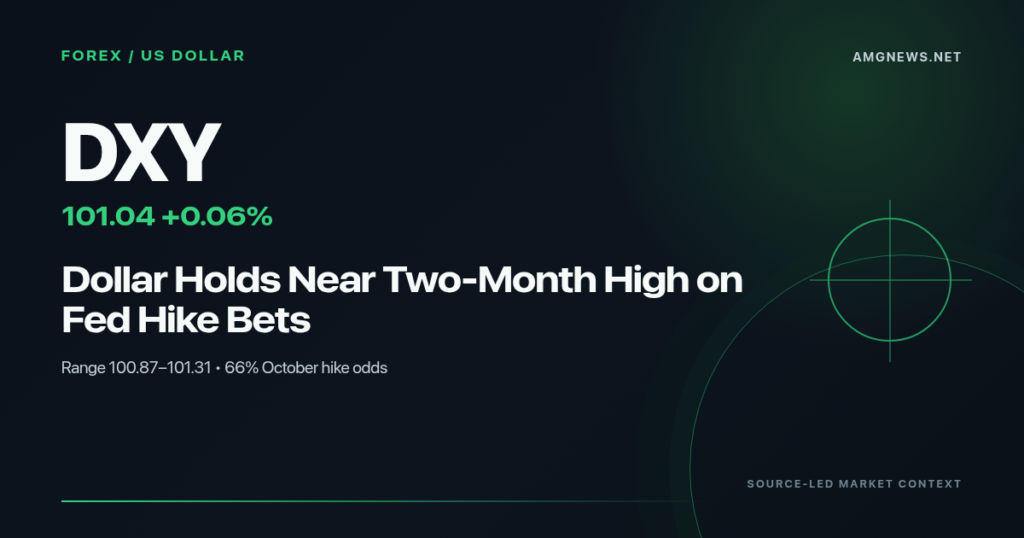
Dollar Holds Near Two-Month High on Fed Hike Bets
Dollar dips but weekly gain remains The newer Reuters report said the dollar declined on September 25 as oil prices eased, but...
USD/JPY Weekly Analysis: Yields, Policy Signals, and Intervention Risk
Key takeaway: USD/JPY weekly analysis should combine the U.S.-Japan yield differential, official policy communication, and market positioning. Intervention risk can change volatility...
Bitcoin DXY Correlation: Does Bitcoin Move With the Dollar Index?
Key takeaway: Bitcoin DXY correlation is a useful research question, not a permanent rule. Compare the time window, the market regime, rates,...
