How to Read Bitcoin Dominance Without Misreading Altcoin Season
Bitcoin dominance measures Bitcoin share of total crypto market value. Learn what it can show, what it cannot prove and which companion metrics improve the read.
In this article
Quick answer: Bitcoin dominance is Bitcoin’s share of total crypto market capitalisation. A falling percentage can mean altcoins are rising faster, but it can also reflect a broad market move, stablecoin supply changes or price shifts in large assets. Read it with total market cap, volume and liquidity.
Dominance is a market-structure metric, not a guaranteed altcoin-season signal. Its value comes from asking why the percentage changed.
How the metric works
Bitcoin market cap is divided by the market cap of the crypto assets included in the data source. Different providers include different assets, so the number can vary. Always compare the same source and time frame.
What a falling dominance can mean
- Altcoins are outperforming Bitcoin.
- Stablecoin or token supply has changed the denominator.
- Risk appetite is moving into smaller assets.
- Bitcoin is flat while other sectors attract activity.
What to check next
Compare Bitcoin dominance with total crypto market cap, Bitcoin price, stablecoin liquidity, ETH/BTC behavior and sector volume. If dominance falls while total market cap also falls, the move may reflect weakness rather than healthy rotation.
AMG News view
Use dominance to frame market leadership, not to select a token. A strong signal needs confirmation from price, liquidity and actual participation.
FAQ
Does low Bitcoin dominance mean altseason?
No. It may show rotation, but a durable altseason requires broad participation and sustained liquidity.
Why do dominance charts differ?
Data providers use different asset lists, market-cap methods and stablecoin treatment.
Related reporting
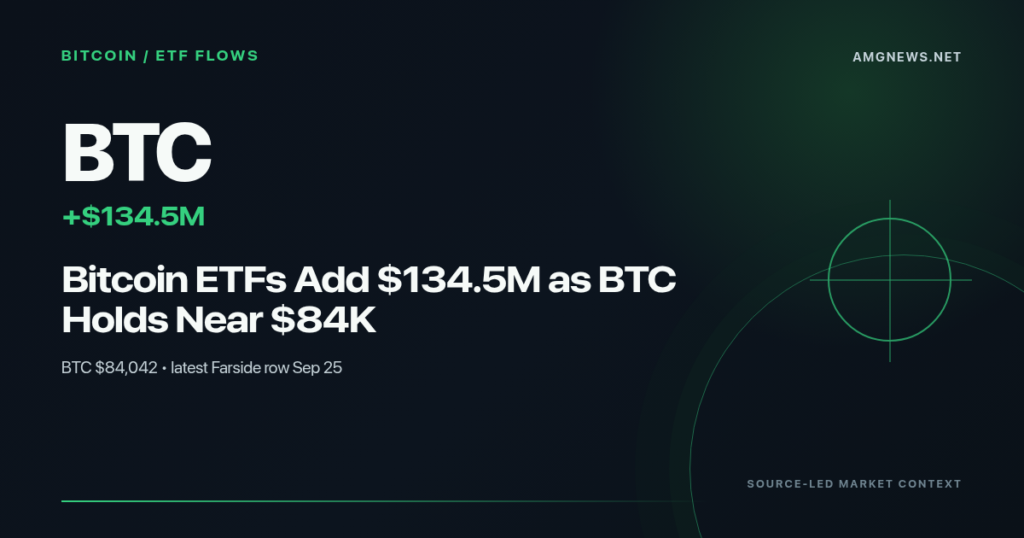
Bitcoin ETFs Add $134.5M as BTC Holds Near $84K
September 25 is now the latest row U.S. spot Bitcoin ETFs recorded $134.5 million of net inflows for September 25, according to...
Dogecoin Market Analysis: Liquidity, Sentiment, and Utility
Key takeaway: Dogecoin market analysis should separate attention from evidence. Liquidity, network activity, market breadth, and volatility can be measured; sentiment can...
TRUMP Token Analysis: Volatility, Supply, and Market Risk
Key takeaway: TRUMP token analysis should begin with identity and data quality, not branding. Verify the contract, supply, holders, liquidity, disclosures, and...
